Street Design Has Five User Categories. Delivery Riders Don't Fit Any of Them.
Excerpt
Pedestrian. Cyclist. Transit rider. Motorist. Freight operator. Every modern street design guide sorts people into one of these five boxes. Nobody's checked which box the delivery rider actually belongs in.
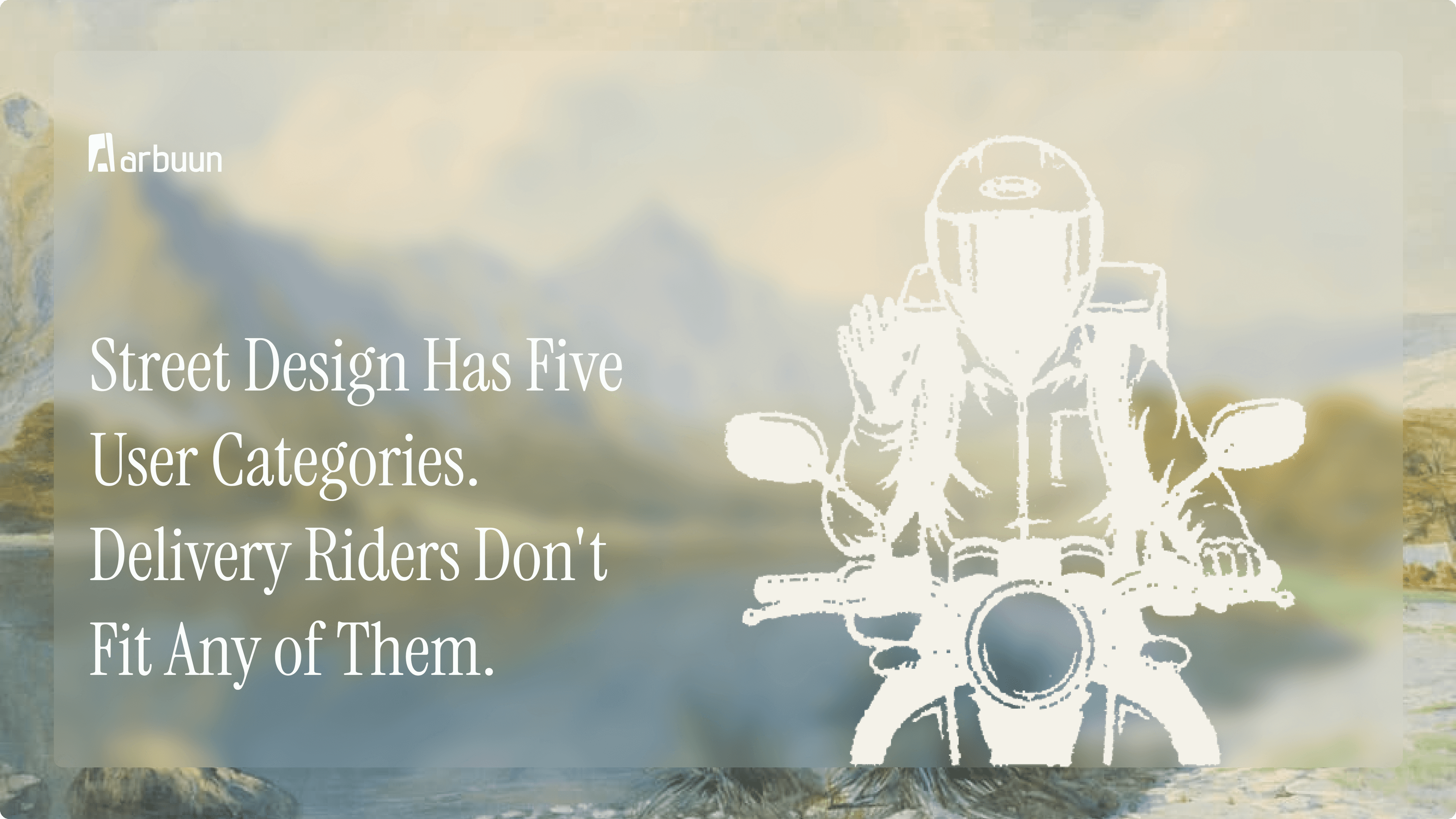
Pedestrian. Cyclist. Transit rider. Motorist. Freight operator. Every modern street design guide sorts people into one of these five boxes. Nobody's checked which box the delivery rider actually belongs in.
The five boxes we've been using for years
Most street design frameworks, including the ones that shape Indian planning guidelines, split users into the same five categories: pedestrians, cyclists, transit riders, motorists, and freight or service operators. Each one comes with its own design logic. Cyclists get protected, continuous cycle tracks. Freight operators get their own loading and turning allowances, kept separate from private vehicles. It's a clean system, and it's worked well for a long time.
It just wasn't built with today's most common new street user in mind.
Where does a delivery rider actually go?
Take a Zomato or Swiggy rider on a two-wheeler, doing thirty stops a day through the same few streets. Which box do they belong in?
Not cyclist, most are on two-wheelers, not bicycles. Not motorist, motorists are assumed to travel point to point, not stop every few minutes. Closest fit is freight and service operator, but that category was built around delivery trucks making a handful of scheduled stops a day, not a rider making dozens of two-minute stops, all day, every day.
The honest answer: they don't fit anywhere. The five-box system was designed for a version of the street that existed before quick commerce.
The number that makes this hard to ignore
India had 7.7 million gig workers in 2020. By 2025, that number had doubled to 15.4 million, and it's projected to hit 23.5 million by 2029-30. Zomato alone has over 400,000 riders on the road. Quick commerce, the 10-15 minute delivery model, has already added 450,000 jobs and is still growing.
That's not a niche user anymore. In a lot of dense Indian neighborhoods, at meal times, a delivery rider passes through more often than a private car does. A design framework built for five categories of user is now missing what might be the single most frequent user on some streets.
Why "just a motorist on a bike" doesn't hold up
Three things make this rider genuinely different, not just a busier version of an existing category.
How they move. Short trips, constant stops, no fixed destination pattern, nothing like a commuter's one trip in, one trip out.
How exposed they are. Two-wheelers already sit in the "vulnerable user" group alongside pedestrians and cyclists, no vehicle shell, highest risk of serious injury in a crash. A rider who's stopping and starting in traffic all day carries more of that risk than one who's simply commuting twice.
What they actually need from the street. Not a wider lane. A legal, safe place to stop for sixty seconds to two minutes, dozens of times a day, something closer to a transit stop or loading zone than anything built for private vehicles.
There's already a tool for exactly this. It's just never been used here.
Planners use something called a design vehicle, a representative user picked to size a street or facility around, so it isn't over-built for a rare user at the cost of the people who actually use it daily. Existing examples include a wheelchair user for sidewalks or a cargo bike for cycle facilities.
Nobody has defined a "high-frequency delivery two-wheeler" as a design vehicle for dense commercial corridors, even in the streets where it may already be the most common user during peak hours. The tool exists. It's just pointed at the wrong five categories.
What actually needs to change
Formalizing this as its own category isn't a big ask, it's mostly about using the existing playbook on a user it was never applied to:
A defined design vehicle profile for delivery two-wheelers, stopping frequency, dwell time, turning space
Short-duration stopping zones on the curb, separate from parking and loading docks, sized for a two-minute stop
Corridor-level data on where delivery stop density is actually highest, the same way transit stops get sized using ridership data
Where this isn't settled
Some planners would argue this rider is just a subset of existing motorist or cyclist categories, and that "design for all users" principles already cover them without a new box. That's a fair point on paper. But those "design for all" principles are aspirational, they're not the specific, operational categories planners actually design corridors against. And an operational category is exactly what's missing here.
The corridor-level problem, again
This isn't a citywide fix, and it was never going to be. Delivery worker density clusters in specific pockets, commercial high streets, residential lanes near dark stores, not evenly across a city. Which means the fix has to start where the data does: knowing, corridor by corridor, how much delivery traffic is actually moving through, stopping where, and how often. That's not something a citywide policy or a zoning map can answer. It's a site-level question, and right now, almost nobody's asking it.
We've been designing streets for users who existed twenty years ago. The busiest user on many streets today doesn't have a category yet.
Arbuun is building the reference layer for due diligence in Indian urban development, starting with the data most site evaluations still lack.