How Much Sky You See, From Your Street, Decides How Hot You Will Feel Standing There
Excerpt
Two streets, same city, same weather forecast. One feels unbearable after sunset, the other doesn't. The difference isn't the temperature — it's what's above your head.
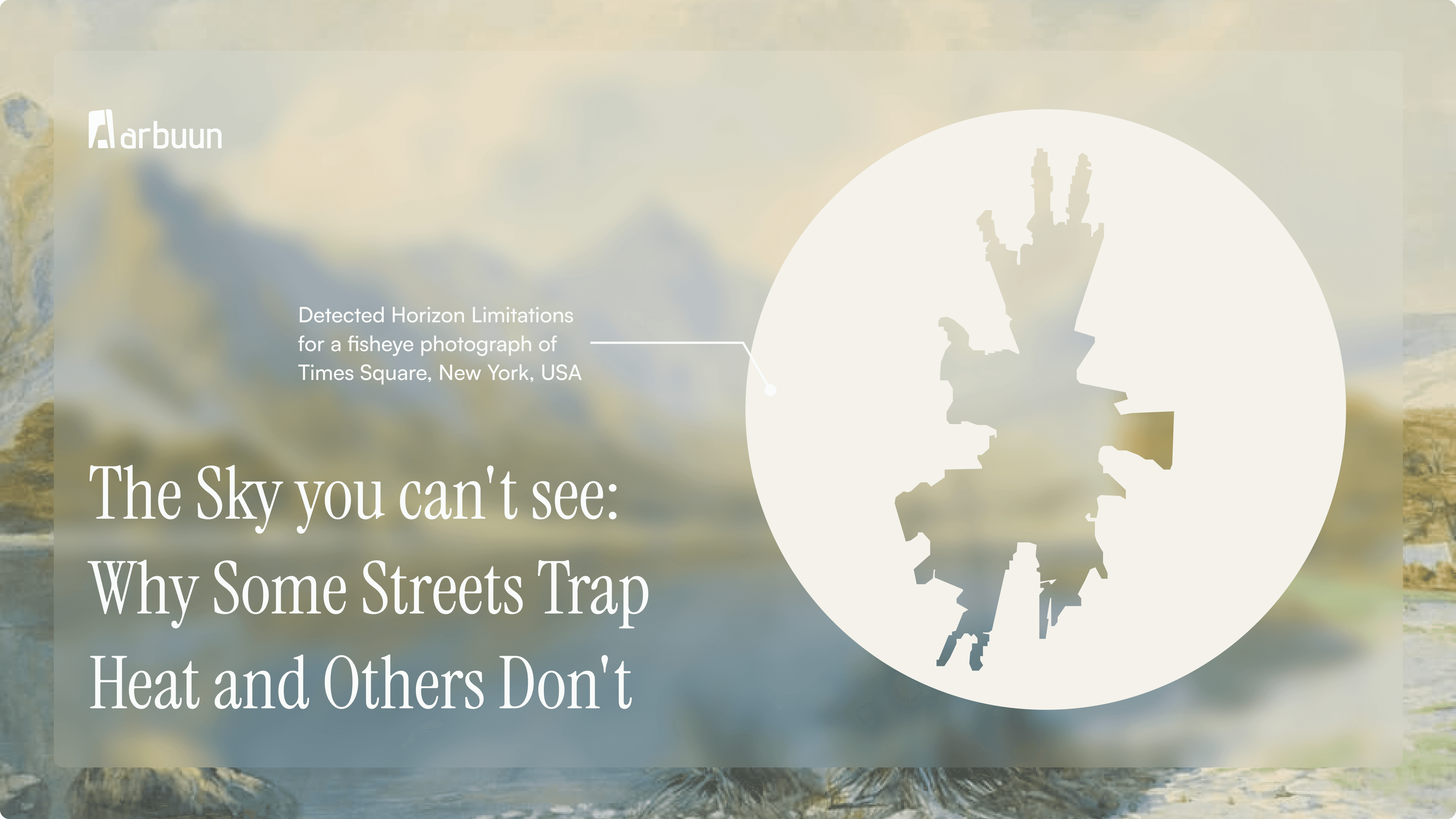
Two streets, same city, same weather forecast. One feels unbearable after sunset, the other doesn't. The difference isn't the temperature on the weather app, it's what's above your head.
A number nobody checks
There's a name for this: Sky View Factor, or SVF. Stand at any point, look straight up, and measure how much sky you can actually see. Stand in an open field and it's close to 1, almost the whole sky. Stand in a narrow lane between two tall buildings and it might drop to 0.2, just a sliver of sky squeezed between the rooftops.
Most site assessments skip this entirely. Planners check FAR, setbacks, zoning compliance, the usual paperwork. Nobody's standing on the street with a fisheye lens measuring how much sky is left. But that missing number quietly decides how a place feels, hour by hour, long after the paperwork is approved.
Why a low number means trapped heat
Picture a narrow lane in Old Delhi, buildings packed close, four or five storeys high. During the day, those walls block a lot of direct sun from reaching the ground. You'd expect that to keep things cool. It doesn't.
Here's the catch: the same buildings that blocked the sun by day also block the ground from releasing its heat back into the sky by night. Heat gets trapped between the walls instead of escaping upward. That's why dense, narrow streets often feel hotter after dark than open ones, long after the sun is gone.
Manhattan is the clearest large-scale version of this. Walk between two 50-storey towers in Midtown and the sky view at street level can fall below 0.2. Night-time temperatures in dense Manhattan blocks have been measured running 5-7°F warmer than the suburbs just outside the city. Stack on dark asphalt soaking up heat all day, glass throwing it back down, and millions of air conditioners exhaling warm air into the street, and you get one of the most studied heat islands on the planet.
But deserts flip the whole story
Deserts are brutally hot too, for the exact opposite reason.
Open desert has almost nothing blocking the sky. The sky view here is close to 1. No canyon, no trapped heat. So why does it still feel like standing in an oven?
Because the problem isn't what's blocking the sky, it's what's missing on the ground. Dry sand heats up fast under direct sun because there's no moisture and no vegetation to absorb or slow that energy down. And at night, that same open sky that let the sun in all day lets the heat straight back out. No clouds, no humidity to hold it in place, ground heat escapes into space fast.
That's why deserts swing so violently between day and night. The Thar Desert can hit 45-48°C by afternoon and fall below 25°C by midnight. A wide-open sky cuts both ways: it lets heat in fast, and it lets heat out just as fast.
Same number, opposite outcome
Sky visible from ground | By day | By night | |
|---|---|---|---|
Manhattan-style street canyon | Low | Some shade from buildings | Heat trapped, stays warm |
Open desert | High | Heats up fast, nothing to slow it down | Cools fast, nothing to hold it in |
Cities trap heat because too little sky is visible. Deserts cool down fast at night precisely because too much is. Same measurement, opposite result, because heat was never just about how much sky you can see. It's about everything else in the picture too: humidity, vegetation, building material, all acting alongside it, not instead of it.
Why this belongs in every site assessment
None of this is exotic physics. It's the kind of thing that should show up before a building gets designed, not after residents start complaining about how hot their street feels at 11pm. Two sites can have identical FAR, zoning, and setbacks on paper and still behave completely differently once you account for how much sky each one actually sees.
That's the gap most site diligence still misses, and exactly the kind of ground-truth detail that belongs next to zoning and FAR checks, not buried behind them.
The parameters that decide if a street is livable are almost never the ones written into a zoning report.
Arbuun is building the reference layer for due diligence in Indian urban development, starting with the data most site evaluations still lack.